
Qualcomm just "snapped" the competition
A quick look at the Snapdragon 8 Elite Gen 5 and X2 Elite/Extreme


Meme’s aside, today’s announcement at Qualcomm’s yearly Snapdragon Summit was a big one. Not only did they announce a slew of new and updated products, but they also showcased the new 3rd generation Oryon CPU core which now powers both their mobile 8 Elite Gen 5 and X2 Elite compute chips.
Using the same CPU cores in both offerings make sense - streamlined development, better performance across product offerings, and more. This also allows Qualcomm to ‘scale’ the cores to any device they want. Whether it’s a mid-range device to a desktop video editing machine, these cores can power it all.
8 Elite Gen 5
Let’s start with the mobile offering, the newly name changed 8 Elite Gen 5. This is an upgrade building off of last year’s 8 Elite chip with the newer v3 Oryon cores. This lets them offer some pretty staggering benefits compared to last generation, along with plenty of new features.
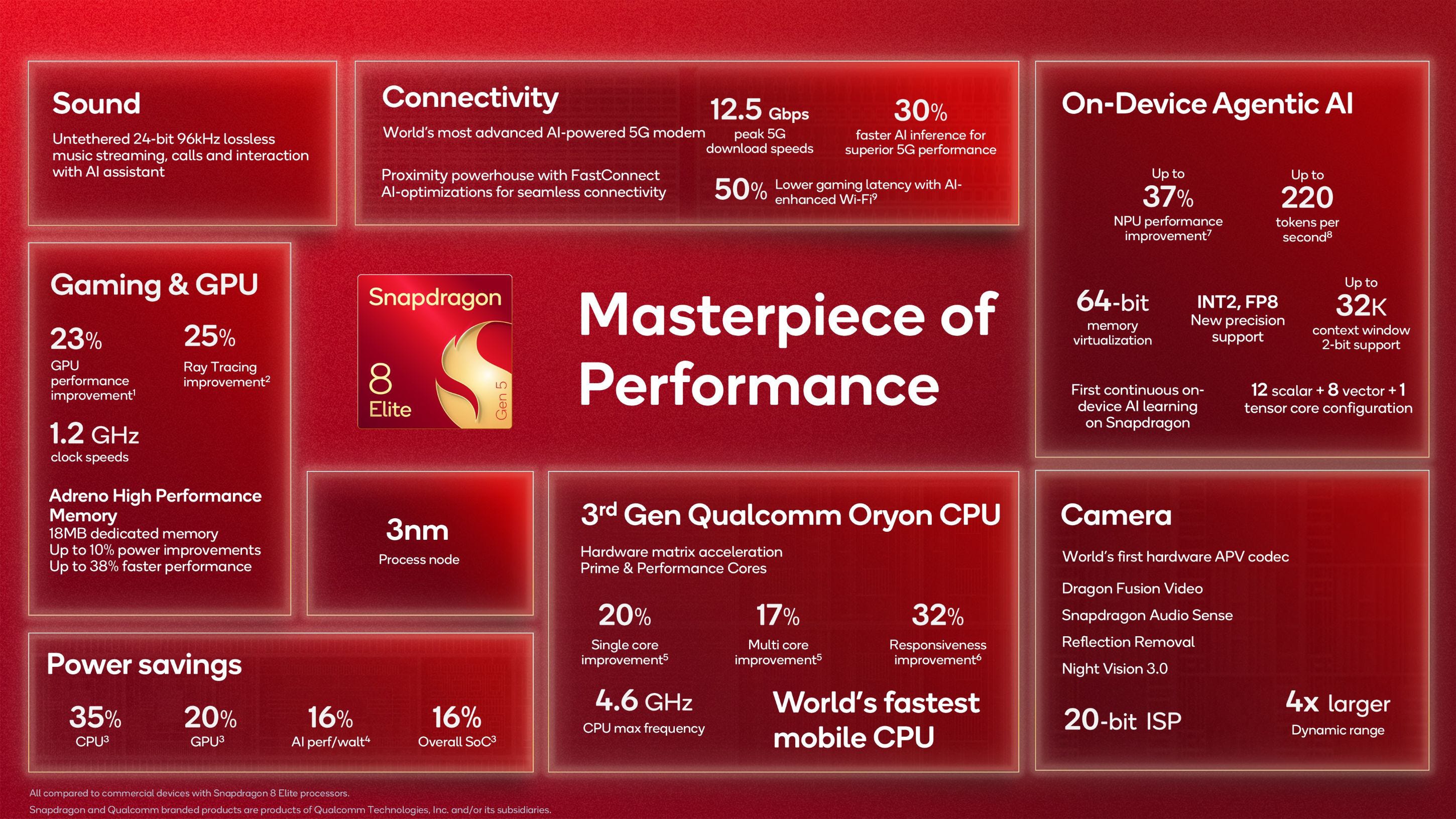
One of the themes throughout the announcement was an emphasis on “agentic AI”, which means an AI that can learn and pro-actively help you instead of relying on being prompted. This is made possible by improvements to the NPU (neural processing unit), allowing more on-device AI processing (more TOPS) with better efficiency, and Qualcomm states that there is up to 37% performance improvement from previous generation.
One other feature that caught my attention was a move to the APV (Advanced Professional Video) codec, with an emphasis on creative content like video, photo, editing, etc. I had not actually heard of this codec before since I’m used to the most popular codecs for encoding such as H.265/264, AV1, VPC, etc, so this piqued my interest. As you’ll read further on, more emphasis was put on hardware encode/decode support for popular codecs, including APV, which is a huge bonus for those that do any sort of creative work with their computers. The APV codec is similar to Apple’s ProRes (if you are familiar with that) which is geared toward video editing. If you want to learn more about APV and the companies supporting it, check out this link.
X2 Elite and Elite Extreme
Now onto the compute space, which is where I live and what excited me the most. When the Snapdragon X Series originally launched it arguably caused the largest market disruption since AMD’s Ryzen was launched. Qualcomm was the new kid on the block in the consumer compute space, but its product offerings were acting as though they had already been around the block, even beating the old guard players in performance and power efficiency.
Fast forward to now with the X2 Elite series and we’ve got a major upgrade:
3nm process node
Up to 18 cores and 5.0 Ghz
Up to 50% faster and 43% less power vs previous gen
80 TOPS NPU and up to 78% faster processing vs previous gen
2.3x faster GPU vs previous gen and support for DirectX 12.2 Ultimate
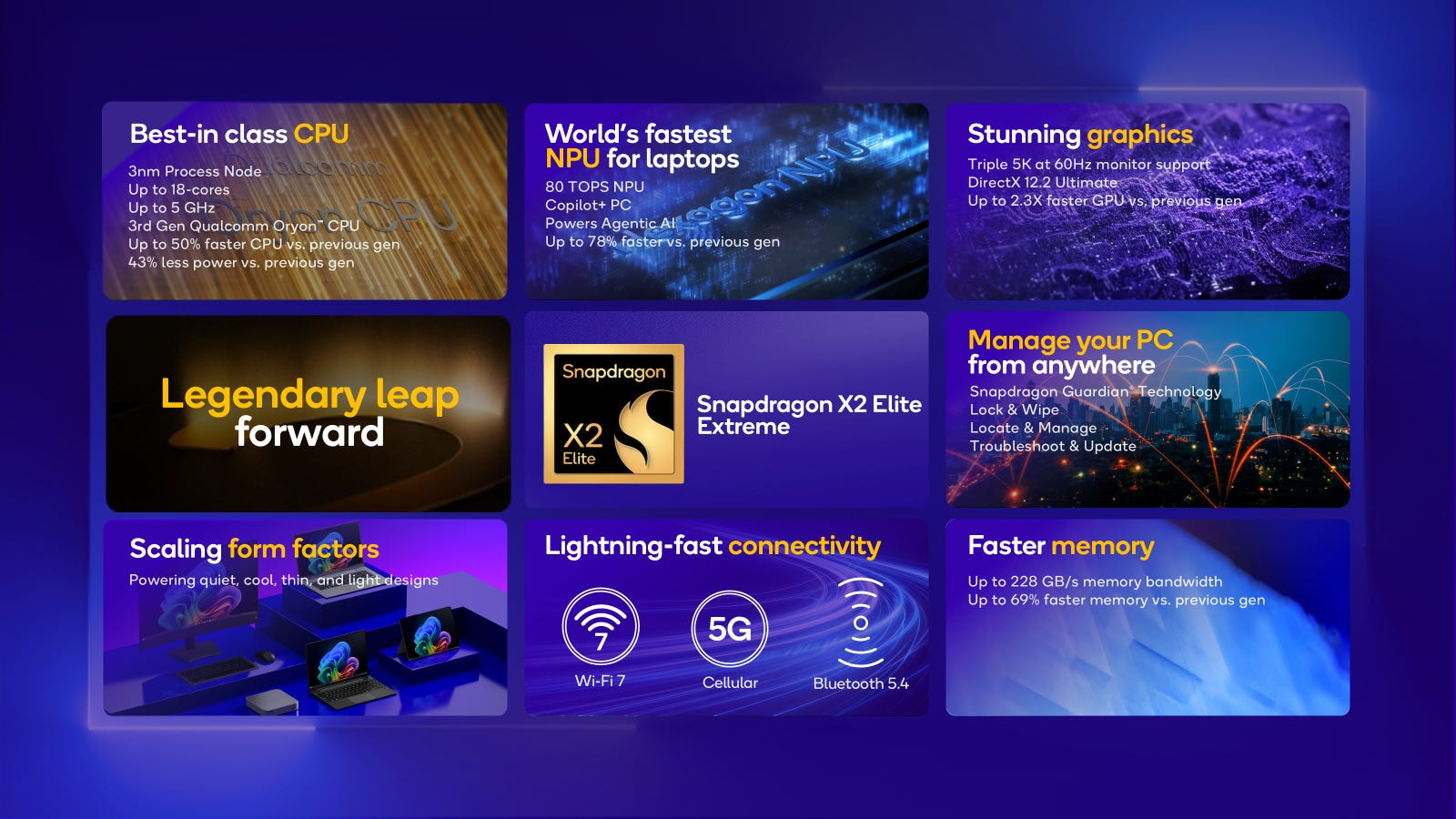
As someone who has been using an X Elite system for the past year or so, this news is very exciting. We are seeing some pretty big gains coming from the first-generation Oryon cores here with some early benchmarks shown at Summit, and it looks like this will be one powerhouse of a chip. Qualcomm showcased a popular game (Fortnite) that was previously not compatible with Windows Arm due to kernel level anti-cheat software (Unreal’s Easy Anti-Cheat) running at 60fps at a 4k resolution, which is very impressive. According to Epic, Fortnite should be available on Windows Arm devices “soon”.
Qualcomm has also listened to feedback in the creative space with improved encode/decode options and colour space and chroma sampling support (including 10-bit colour and 4:4:4, 4:2:2 options), in addition to supporting the APV codec, which will be a huge boon for those in the creative space who use their PC for any type of video editing.
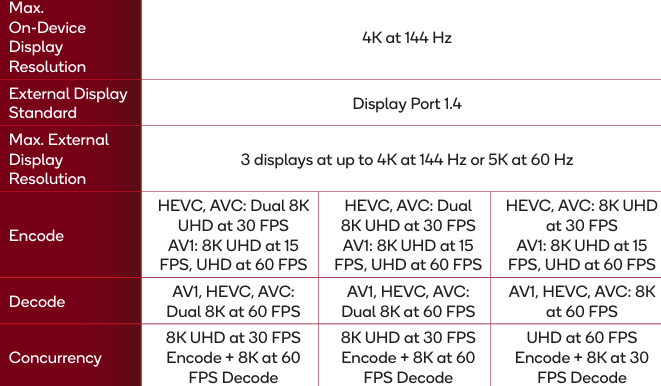
This also includes support for additional display resolutions and refresh rates on external monitors which was a limitation of the previous generation of chips.
Finally, the X2 Elite series features an 80 TOPS NPU, allowing up to 78% faster performance than the previous generation in on-device AI tasks. Since Qualcomm seems to be taking “agentic AI” to the next level, having more on-device processing for AI makes sense, allowing for your personal information to remain on-device and in local models rather than transversing the cloud. Not only does this improve performance, but it also improves energy efficiency by offloading the processing from the CPU or GPU. Having more available AI processing will allow more of these processes to happen at the same time, giving you that “AI is the UI” experience if you have the apps installed to take advantage of it.
Performance and battery life
A thread weaved into both announcements today was energy efficiency and battery life. The 8 Elite Gen 5 boasts up to 35% less power use (compared to previous versions), while the X2 Elite was up to 43% less (compared to previous versions), which is very impressive. These gains are a combination of design changes of the chips themselves from the current first-generation Oryon cores and the new 3nm process node. It will be interesting to see real-world numbers once consumer devices start shipping to reviewers.
Enterprise features a much-needed addition
You may have missed this piece of the keynote, but Qualcomm also announced a new feature aimed at enterprise customers, dubbed Snapdragon Guardian. If you’ve ever worked in the enterprise IT space, you know that remote managing systems is one of those tasks that can be easy with the right tools, or near impossible without them. Intel offers a similar tool for business models called Intel AMT, which is part of their vPro lineup of chips designed for enterprise customers. Seeing a similar feature from Qualcomm shows their commitment for the enterprise space and IT management.
With features such as remote help, offline device find, always-on cellular connectivity and more, Snapdragon Guardian is shaping up to be as good if not better than Intel’s offering in this space. Of course, we’ll have to see the management capabilities and if there are any additional costs associated when business devices start releasing, but I will cover that when the time comes.

Coming to devices soon
Qualcomm has stated that devices with the X2 Elite will start showing up in the first half of 2026, while devices rocking the 8 Elite Gen 5 will be released in the coming days.
For more information on any of these announcements, check out Qualcomm’s website.